Showing posts with label dolphins. Show all posts

Monday, October 10, 2022

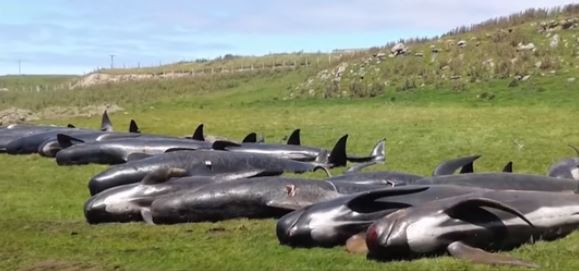
Hundreds of pilot whales stranded on remote island off the east coast of New Zealand

Pitt Island is the second-largest island in the Chatham archipelago. This is about 500 miles east of the country's mainland. Nearly 250 pilot whales are stranded on this remote island off the east coast of New Zealand. It has happened within a few days of each other. During the weekend, most of the whales died while the remaining had to be put down since there was little chance of their survival. An official of Project Jonah revealed to a section of the media that two mass stranding within a few days was "not unheard of." However, the remoteness of the islands made things difficult to rescue them. Usually such cases involve massive community effort with hundreds of people. Unfortunately, the population of Pitt Island is only 40 people. It was totally inadequate to tend to such a number of whales. Hundreds of pilot whales stranded off remote islands in New Zealand.


Mass whale stranding is not new to the Chathams. The largest was in 1918, when an estimated 1,000 whales died. Later in 2000, more than 100 whales and dolphins died after being stranded on the islands. The reasons for such behavior are not known but experts do not rule out possibilities of links to environmental factors.in some parts of the world the water is too shallow for whales to navigate. This is because their echo-location ability is designed for deep water. Moreover, mass stranding are more common among highly social species. These include pilot whales. Their herding instinct means the group can move together even if one member is sick or compromised. At times, these result in their stranding. Incidentally, these bonds can be strong. Therefore, the sick whales have to be revived before the healthy ones are re-floated. In case that does not happen, the healthy whales could hear the sick ones calling and re-beach themselves to be together.


Some popular stories of this blogger –

Fort William restarts heritage walk for civilians

At least 25 people dead in central Venezuela landslide after days of torrential rain and floods

Tragedy at Durga Puja immersion in Jalpaiguri, West Bengal when flash flood sweeps away at least 8 persons

Death of over 65s in England highest in summer 2022 compared to 2004 due to heatwaves

America imposes fresh sanctions on North Korea after it conducts more ballistic missile tests

Durga Puja 2022 is over and the mega carnival will bring down the curtains

Massacre of children in Thailand in a knife and gun rampage, condolences pour in

President Tsai Ing-wen of Taiwan wants to achieve self-sufficiency in defense

Mamata Banerjee plays the dhak to begin the Durga Puja festivities

Monday, December 21, 2015

Ganga is polluted by dead bodies of animals and humans


#pollution #ganges #NarendraMod #NamamiGange #ITBP An Indo-Tibetan Border Police ITBP expedition team has revealed that one of the factors that contribute to the pollution of the River Ganga are hundreds of floating bodies of humans and animals, funeral on the banks and less flow of water in the mainstream.
This has been reported in ibnlive.com dated 22 December 2015.
The revelation is by a special team of the ITBP which set off on the 'Swachh Ganga' river rafting mission on October 2 from Devprayag in Uttarakhand to Gangasagar in the Bay of Bengal. This was a part of Prime Minister Narendra Modi's 'Namami Gange' project.
The 2,350-Km long expedition covered the states of Uttarakhand, Uttar Pradesh, Bihar, Jharkhand and West Bengal. The ITBP teams noticed at least 20 human bodies floating in the Ganga mainstream, 200 carcasses of various animals and about 100 half-burnt or un-burnt human bodies which were lying near the banks of the holy river.
The teams also found that "90 per cent of Ganga water was diverted for irrigation" and, as a result, there was not enough water in the mainstream.
Moreover, the squad, during its 72-day long voyage, also tested and handed over to the authorities samples of Ganga water from 50 big and small cities that it passed through - they found harmful traces of Nitrate, Phosphate, Ammonia, Fluoride and Chloride in the water.
Other observations include - lots of soil erosion on Ganga's banks. Fishing and hunting of tortoises from the river are being done in excess. They did not spot any Gangetic alligator but did come across about 1,200 dolphins specific to the eco-system of this life-giving river of the country. In addition, they found excessive use of detergents and soaps on the banks of the river at several places.

(Image courtesy wikimediacommons.org)

Rice on rooftops – a masterplan (satire)

Didi to gift soaps and towels to kids (satire)

Saraswati and Lakshmi and their girlish talks (satire)


Juhi Chawla learns how to ride a scooty

All female pop-group Moranbong Band cancels China goodwill tour

Eagles Of Death Metal to perform at the Olympia Theatre on 16 February


No country liquor in Bihar from April - only Indian Made Foreign Liquor (IMFL)

Thieves make away with sandalwood trees from Santiniketan

76% of butterflies vanishing in Britain - a result of climate change


1,000 British troops and Special forces going to Libya to eliminate ISIS jihadists

United States faced with Syrian refugee influx - nearly 100,000 have entered since 2012

Scotland Yard launches biggest ever crackdown on guns in London

Friday, June 12, 2015

Polar bears in the Arctic feed on dolphins – blame it on global warming


Polar bears in the Arctic are known to usually feed on seals but, it has now begun to feed on dolphins as well and, in the opinion of scientists, global warming is to blame.
This has been reported in news.sky.com dated 12 June 2015.
It is the first time that the polar bears have been seen eating dolphins in the Arctic. The predators feed mainly on seals, but Norwegian Polar Institute has photographed a bear dining on dolphins. The reason could be attributed to climate change which is making new species to find their way up north.
The first incident had been recorded by the Institute in April 2014 when a polar bear was found to be feeding on the carcasses of two white-beaked dolphins.
Incidentally, dolphins are a regular sight in the Norwegian Arctic during summer when the ice melts but has seldom been seen during winter or spring when the sea is usually still covered in sheets of ice.
Following the first documented incident, there have been five more cases of dolphins being stranded or captured and then eaten. This can be explained by the fact that the polar bear is now coming in contact with new species of marine life due to global warming.
(Image courtesy wkimediacommons.org)

A few more must reads -

Nashik Kumbhmela 2015 – a once in 12-years pilgrimage

Trip to Nashik should take in Shirdi and the Ajanta and Ellora caves

Nashik, a tourist center with links to the epic Ramayana

Nashik, a tourist center with links to the Mahabharata

Kumbhmela 2015 in Nashik – guided tours to wineries and vineyards

Nashik transforms from a place of pilgrimage to an industrial hub


Kolkata Police to send cake with birthday greetings to 12000 senior citizens of Pronam

Maggi 2-minute noodle – Madhuri Dixit, Amitabh Bachhan and Preity Zinta had endorsed the product

Bogus tour operator charged out-of-towners $200 each way for a trip that is free

WHO says cigarette smuggling into India has increased fourfold

Marvels of technology – robotic cheetah created by MIT, it can jump over obstacles

The power of tulsi leaves – it keeps at bay the pacemaker

US admits - there is no way to monitor online encrypted messages of ISIS

US Police have killed two persons daily in first 5-months of the year

Sunday, March 22, 2015

Campaign kicks off in Kolkata to protect the dolphins in the Ganges


In Bengal, the dolphins are commonly known as ‘susuk’ or the ‘tiger of the Ganges’ and efforts are on by the WWF to make people aware of these mammals and the need to protect the roughly 2000 odd number of dolphins that can be seen in the waters in the vicinity of Kolkata.
This has been reported in zeenews.india.com dated 22 March 2015.
The 'River for Life' campaign by WWF is a three-day campaign that is being run on a cruise and was started from the Millennium Park. The intention is to interact with children and youth from schools and colleges near the river to sensitize them in order to make them aware to the fact that the dolphins need to be protected.
The campaign would focus on the local community at different points across the length of nearly 200-Km stretch from Kolkata to Nabadwip in places like Belur, Sobhabazar, Chinsurah, Chandannagar.
The message is to keep the Ganga clean and experts on board the cruise sighted at least 12 dolphins during the journey. Regular travelers on the river Hooghly, as Ganges is known in West Bengal, have seen the greyish brown dolphins jumping in and out of water.

A few more must reads -

Nashik Kumbhmela 2015 – a once in 12-years pilgrimage

Trip to Nashik should take in Shirdi and the Ajanta and Ellora caves

Nashik, a tourist center with links to the epic Ramayana

Nashik, a tourist center with links to the Mahabharata

Kumbhmela 2015 in Nashik – guided tours to wineries and vineyards

Nashik transforms from a place of pilgrimage to an industrial hub


First Russian woman cosmonaut returns to Earth after six-month stay in ISS

European court terms obesity as a disability

Health tips – lose weight without dieting

Sunshine means Vitamin D – good for health in measured dose